


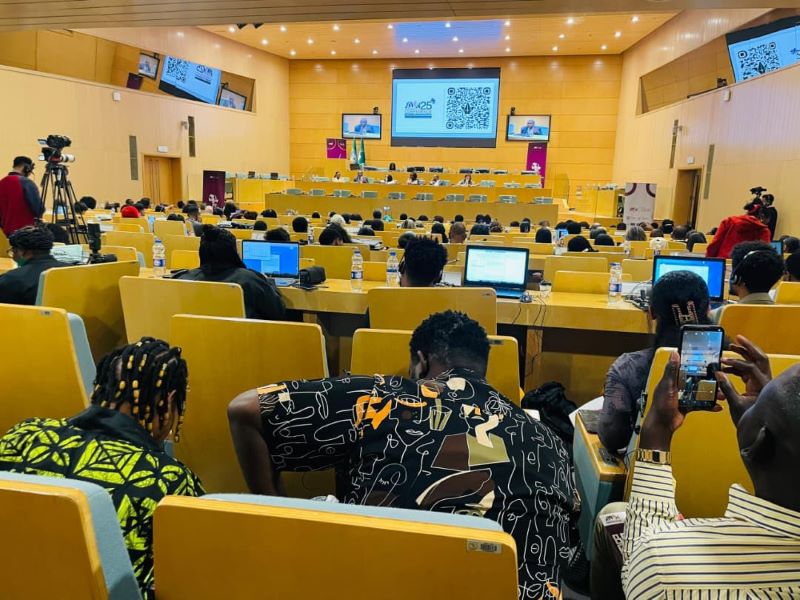
The room at the African Union headquarters settled into attentive focus as Commissioner Ourveena Geereesha Topsy-Sonoo, the AU’s Special Rapporteur on Freedom of Expression, outlined Africa’s newest attempt to rein in a digital space spiraling out of control during the AWiM 25 conference taking place from 04–05 December 2025 in Addis Ababa. “Platforms are useful,” she said, “but the speed of disinformation and the rise of tech-facilitated gender-based violence require immediate action. We want companies to work with us, not because rules are imposed, but because they understand their human rights responsibilities.”
Her warning came during the AWiM session on information integrity and platform accountability, a topic that is no longer theoretical for many African women. Across the continent, from Nairobi to Lagos to Kigali, women journalists, activists, and ordinary users face escalating online threats, doxxing, impersonation, sexualised harassment, and AI-modified abuse.
A continent navigating chaos: When online violence becomes daily reality
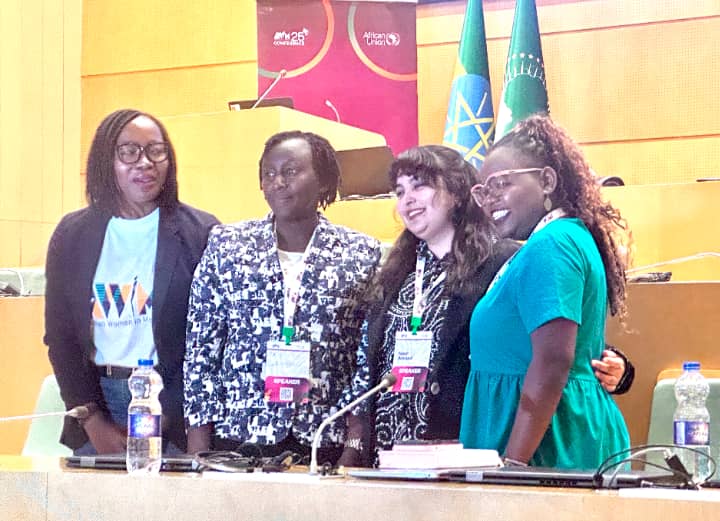
Noor Ahmed the intersectional activist and feminist focusing on youth issues, climate justice, democracy, and media freedom laid out the digital terrain bluntly.
“The online space has become ungovernable,” she said. “Women face doxxing, image-based abuse, cyberstalking, impersonation, shadow fakes, and non-consensual image sharing, now made worse by AI.”
In Rwanda, similar concerns have been documented for years. Studies by the Rwanda Media Commission (RMC) and the Rwanda Women Journalists Association (ARFEM) have highlighted cases where female journalists received harassment after reporting on politics, gender, or corruption. A 2023 RMC safety briefing noted that “online insults targeting women journalists increasingly involve sexualised threats aimed at discouraging public engagement.”
Rwanda’s legal framework appears robust on paper. The 2018 Law on Cybercrimes explicitly outlaws key forms of digital abuse, from online harassment, defined as cyber-stalking under Article 35, to impersonation under Article 40, and even the non-consensual sharing of intimate images, criminalised under Article 34.
Yet, like many African countries, implementation remains a challenge. Cases rarely reach court unless public officials or celebrities are the victims, as a Nigerian journalist in the room pointed out passionately: “You insult a government official, you’re arrested in hours. But women facing sexual harassment online? No action. Impunity is the norm.”
The same “noise” from Addis Ababa resonates also in Kigali during the commemoration of 16 Days of activism against GBV under the theme: “Unite to End Digital Violence Against All Women and Girls” this 05th December. Speaking on behalf of the Rwanda Investigation Bureau, Dr Thierry B. Murangira declared that perpetrators of GBV, including those hiding behind digital platforms will not be tolerated as laws to punish them exist already. His remarks reflected growing concern over cases investigated in recent years, including distribution of intimate images and videos, online blackmail targeting young women…
The urgency was echoed by UN Resident Coordinator a.i. Fatmata Lovetta Sesay, who reminded participants that globally 16–58% of women and girls experience digital violence, 67% face defamation or misinformation, and 73% of women journalists report online attacks. She warned that these are “not abstract figures but violated lives,” insisting that digital transformation must be matched with stronger enforcement, survivor-centred services, and platform accountability. “A connected society,” she said, “must also be safe, inclusive, and grounded in human rights.”
Breaking platform power: Can Africa shape a different accountability model?
For Ivy Gikonyo, a digital justice advocate from Kenya, the biggest challenge is that tech companies want to “set the agenda alone.” She recounted a recent consultation with one global platform: “They were polite, they nodded, but they wanted their framework to lead the conversation. That is why regulatory and human rights mechanisms matter, they break the monopoly.”
She pointed to Kenya’s Computer Misuse and Cybercrimes Act and South Africa’s Films and Publications Act as examples where platforms were compelled, by law, not goodwill, to remove harmful content. “Policies exist,” said Ivy, “but without enforceable duties, platforms can ignore them.When obligations are binding, everything changes.”
Lydia Kembabazi, from the International Press Institute, argued that protecting women online is not simply a technical fix, it is a human rights obligation. “What should be a career of purpose has become a daily struggle,” she said. “Women journalists are being driven out of the public sphere.” She added that Africa’s regulatory future must reflect African values, not imported legal templates. “We need guidelines that a young reporter in Kigali can relate to just as much as a user in Gaborone or Cairo.”
Toward an African-led framework for safer digital spaces
As the discussion opened to the floor, participants echoed a shared frustration: too often, Africa adapts to global tech policy instead of shaping it. “What guiding principles reflect who we are as Africans?” one participant asked. “If platforms serve Africans, then our identity must shape the rules.”
For women battling daily online abuse, such reforms cannot come soon enough. What emerged from the session was not only a recognition of the crisis, but also a shared ambition: Africa wants platforms to understand that accountability is not optional. With coordinated regulation, stronger enforcement, and a human-rights-led approach, the continent hopes to reclaim its digital space as one that informs, empowers, and protects, not one that endangers its most vulnerable voices.
Story by Fulgence Niyonagize