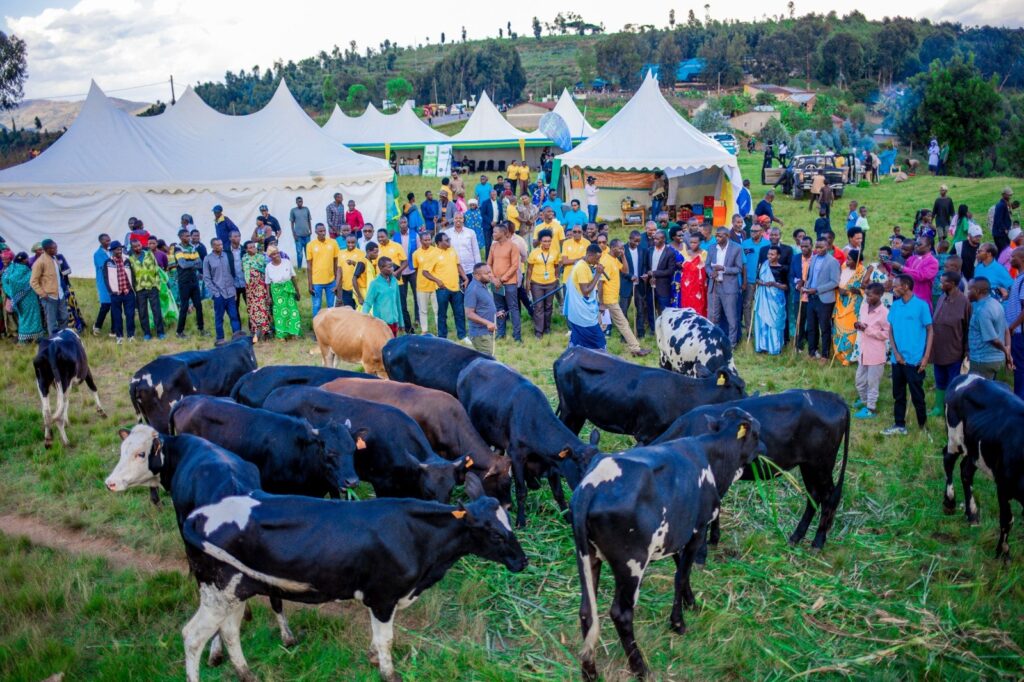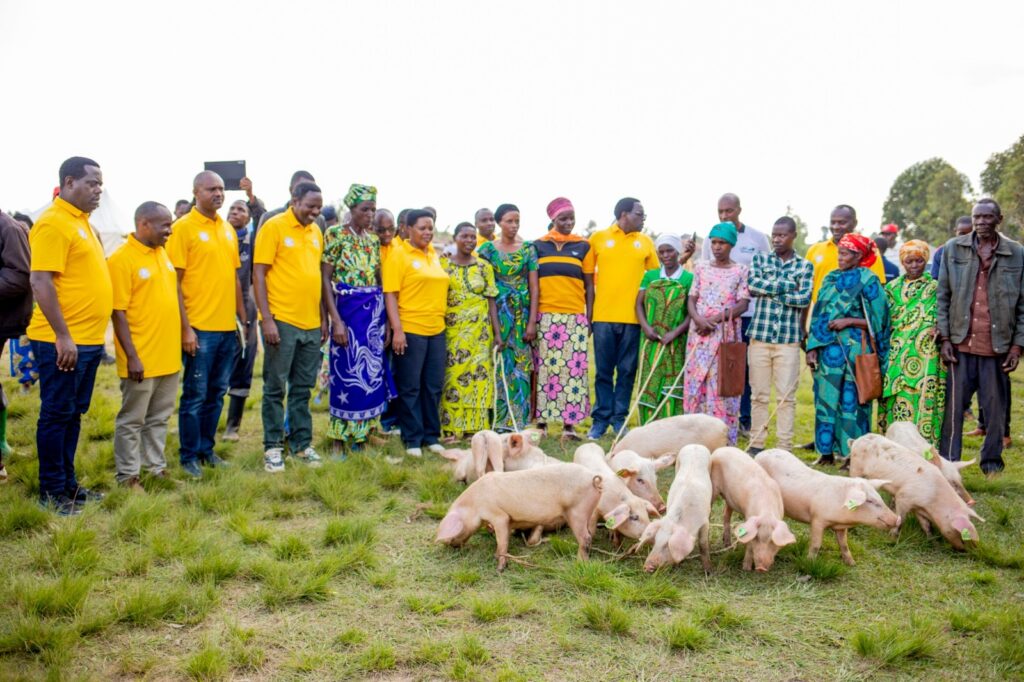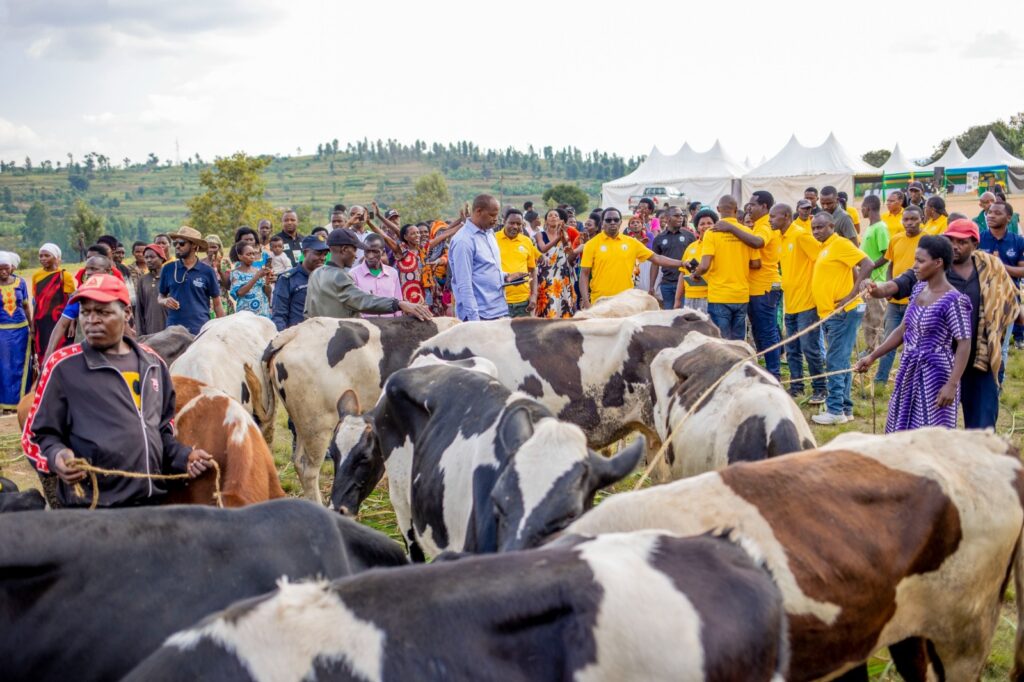
As part of ongoing efforts to improve citizens’ welfare and reduce poverty, Nyaruguru District, in partnership with development organizations, has distributed cows and pigs to vulnerable families in Cyahinda Sector during a week dedicated to activities organized by District Councilors and development partners.
During this action, 21 cows were handed over to beneficiaries, adding to 16 cows that had previously been distributed, bringing the total number of cows provided under the program to 37. In addition, 36 pigs were distributed to vulnerable households to help them improve their livelihoods and strengthen their economic resilience.
According to district officials, the initiative aims to improve household nutrition, increase agricultural productivity through the use of organic manure, and create additional income-generating opportunities for beneficiary families. Livestock farming remains one of the most effective tools for poverty reduction in rural communities, providing families with access to milk for improved nutrition, organic fertilizer for crop production, and opportunities to generate income through the sale of livestock and related products.
Faustin Nzungize, one of the beneficiaries who received a cow, said the support would significantly improve his family’s well-being, particularly the nutrition of his children.
“Accessing milk has always been a challenge for my family, but now my children will be able to drink milk regularly. I sincerely thank the Government of Rwanda, Nyaruguru District, and HELFER for this opportunity. I am committed to taking good care of this cow so that it can help improve my family’s welfare, and in the future, I hope to support others as well,” he said.
Another beneficiary, Innocent Harerimana, said the cow would contribute to both improved nutrition and increased agricultural productivity. “This cow is a valuable gift to my family. It will provide us with milk for consumption and manure to improve the productivity of our fields. We are grateful to the leaders who considered our needs and provided us with a means to improve our livelihoods,” he said.
Among those who received pigs was Jean Bosco Uwineza, who believes the animals will help generate income and expand his family’s economic opportunities. “We are delighted to receive these pigs. They reproduce quickly and can generate substantial economic benefits when properly managed. We are confident that they will help us improve our livelihoods and strengthen our families’ financial stability,” he said.
Thérèse Nyirabunyamanza, another beneficiary, described the support as an important step toward economic empowerment and self-reliance. “Receiving this pig is a significant opportunity for me. I will take good care of it and ensure it reproduces so that I can generate income and improve my family’s living conditions. I am grateful to Nyaruguru District and its partners for giving us this chance to build a better future,” she said.
Dr Murwanashyaka Emmanuel, the Mayor of Nyaruguru District commended development partners for their continued support in implementing programs that improve community livelihoods, with special recognition given to HELFER, which implements the Rural Development and Agricultural Transformation Project Phase II (RDDP II).
“We appreciate the valuable contribution of our partners in implementing programs aimed at improving citizens’ livelihoods. Livestock is more than just an asset; it is a development tool that empowers families to overcome poverty and build a better future. Together, we will continue expanding such initiatives so that more residents can achieve sustainable prosperity,” the Mayor said.
The livestock distribution initiative was implemented through a partnership between Nyaruguru District and RDDP II, a project implemented by HELFER. Of the 37 cows distributed under the program, 30 were provided through the project.
Other partners that contributed to the initiative include INADES, which donated 36 pigs, while NJYANAMA and JADF jointly provided one cow. SEIRA contributed an electric sewing machine and 40 bags of cement, while additional partners provided financial assistance and community health insurance (Mutuelle de Santé) coverage for vulnerable residents.
The initiative aligns with Nyaruguru District’s broader strategy of promoting self-reliance, food security, and sustainable socio-economic development through livestock farming, agriculture, and other income-generating activities. Beneficiaries have pledged to manage the livestock responsibly and use it as a foundation for improving their livelihoods and building more resilient households.