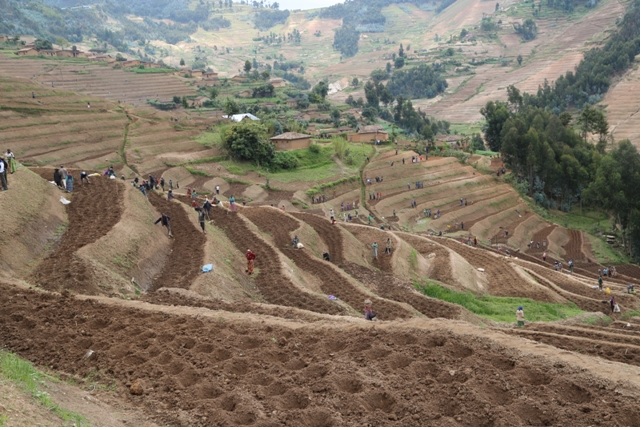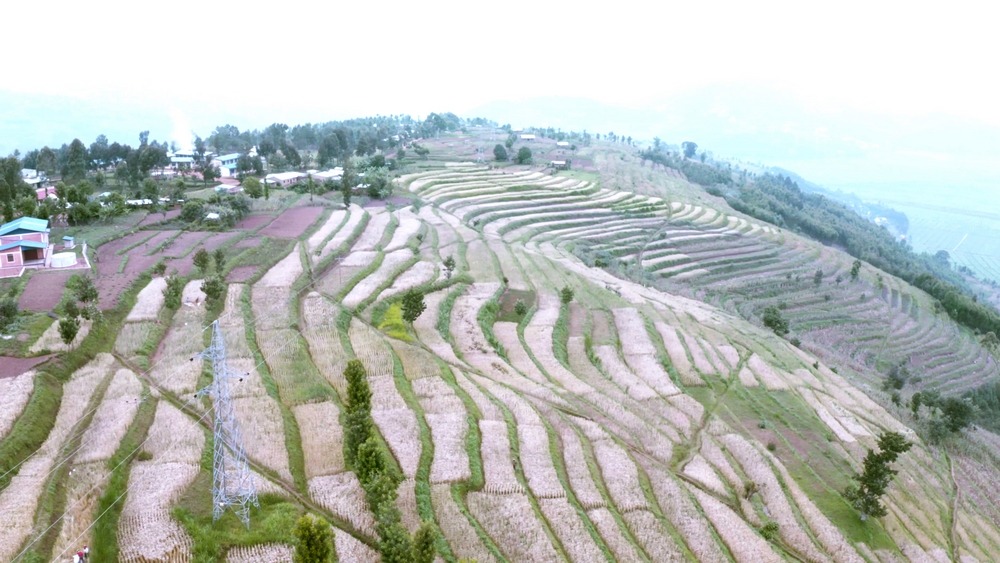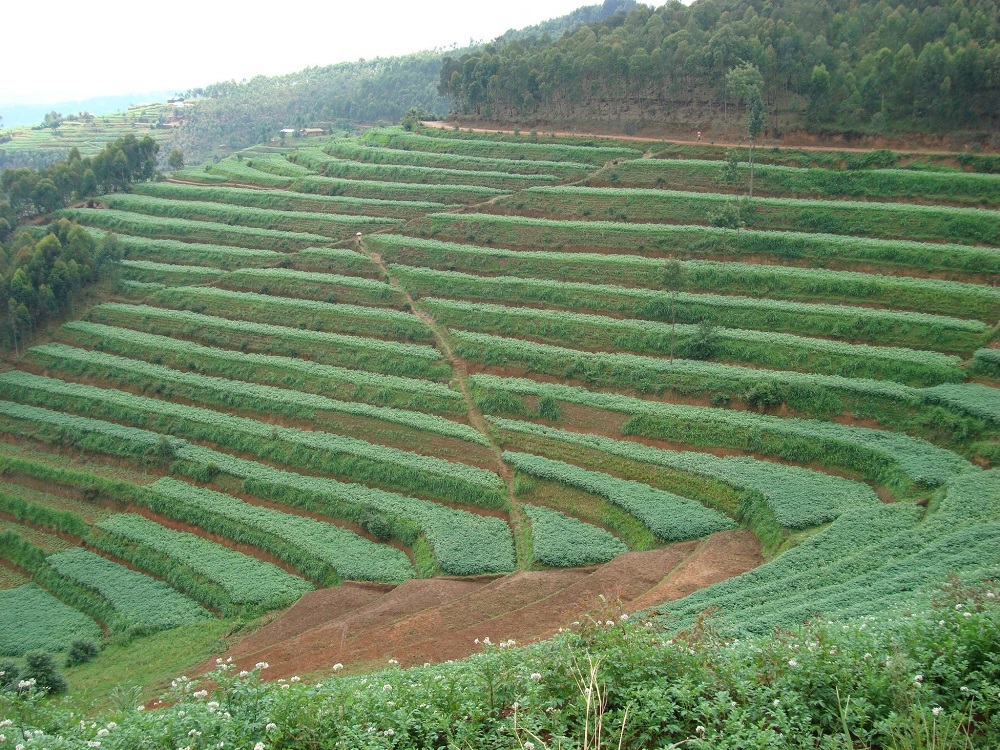
In Rwanda, a country largely characterized by hilly terrain, soil erosion and the loss of fertile land due to rainwater runoff have long posed serious challenges to farmers. To address this problem sustainably, the Government of Rwanda, through the Ministry of Environment and its partners, has invested heavily in the construction of progressive terraces, which have become a reliable solution for sustainable agriculture.
Progressive terraces are a land management technique used on hillsides, where fields are shaped into step-like, level structures. These terraces help prevent rainwater from washing away soil and its nutrients. Beyond controlling erosion, they also contribute to increased crop yields and environmental conservation.
In Burera District, Northern Province, residents who benefited from progressive terraces built under the VCRP project of the Ministry of Environment say their livelihoods have significantly improved.
Mukandayisenga Claudine, a farmer from Rugarama Sector, says: “Before, the rain used to wash away our soil and crops, leaving us with nothing to harvest. Now, because of the terraces, the soil retains water well and our production has more than doubled.”
Habimana Jean de Dieu adds that the terraces also created employment opportunities for him: “We were given jobs to build the terraces and earned income. Later, we were able to farm on fertile land. This helped lift us out of poverty.”
In Gicumbi District, the Green Gicumbi project played a major role in constructing progressive terraces on an area of about 12,000 hectares, with the aim of controlling erosion and increasing agricultural productivity.
The project also provided jobs to local residents, reduced unemployment, and equipped communities with skills in sustainable land management.
Théogène Ntakirutimana, an officer with the Green Gicumbi project in charge of promoting climate-resilient agriculture, explains: “Progressive terraces help retain water, preserve soil nutrients, increase yields, and protect biodiversity. They are a sustainable solution to erosion and climate change challenges.”
Agricultural experts note that progressive terraces produce even better results when combined with modern irrigation techniques.
Nsengiyumva Jackson, an agriculture officer at IPRC Huye, says: “When terraces are combined with irrigation, water is used efficiently and crops grow well even when rainfall is insufficient. This allows farmers to produce throughout the year.”
Between 2023 and 2024, the Government of Rwanda developed progressive terraces on an area of about 138,000 hectares as part of efforts to combat hillside erosion and boost agricultural productivity. From 2024 to 2029, the area under progressive terraces is expected to increase to more than 167,000 hectares, compared to the initially projected 142,000 hectares that were expected to be developed by 2025.
Progressive terraces are a strong pillar of agricultural development in Rwanda. They have helped reduce soil erosion, increase food production, address climate variability, and improve the livelihoods of citizens. They represent a sustainable investment for farmers and for the country as a whole.