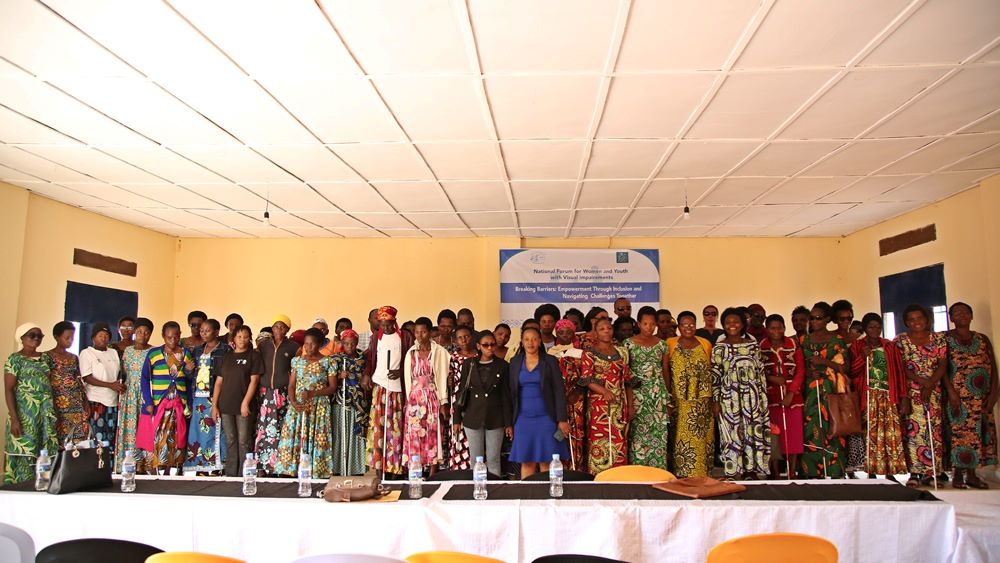
Women with visual impairments from 64 associations of persons with visual disabilities across the country have highlighted the progress achieved over the past 30 years, noting encouraging improvements. However, they also pointed out persistent challenges, including gender-based violence.
They made these remarks on Sunday, December 21, 2025, during a national forum for women and youth with visual impairments held at the Training Center for Persons with Visual Impairments in Masaka Sector, Kicukiro District.
Officially opening the forum, Dr. Betty Mukarwego, President of the Rwanda Union of the Blind (RUB), said this was the first national-level forum of its kind. She described it as an opportunity for women with visual impairments to reflect on where they came from, assess how far they have come, and adopt new strategies aimed at achieving sustainable development for women with visual impairments.
She noted that since RUB began its activities, women with visual impairments and persons with visual impairments in general have made significant progress and gained practical empowerment.
Dr. Mukarwego commended the Government of Rwanda and President Paul Kagame for valuing women and giving them a voice, unlike in the past.
“Women used to be marginalized and excluded from decision-making, and for persons with disabilities it was even worse. We could not access education or enjoy rights like others. Today, however, we have a voice and we are capable.”
She gave her own example, explaining that she holds a PhD despite being visually impaired, and that her disability has not prevented her from serving as a lecturer at the University of Rwanda in the School of Education.

In a presentation delivered by Ms. Donatha Uwitonze from the National Women’s Council, she focused on pathways for the development of women with visual impairments.
She began by explaining the role and responsibilities of the National Women’s Council, including its collaboration with other institutions. She emphasized that women with visual impairments are members of the Council and contribute to the fulfillment of its mandate.
She urged them to move beyond painful past experiences when people with visual impairments were despised, saying:
“When you develop yourself, you contribute to national development. In the past, visual impairment was associated with begging, but that mindset is gradually disappearing because women are being empowered.”
Ms. Uwitonze encouraged them to be confident and recognize their own abilities, noting that many women with visual impairments hold advanced academic qualifications and occupy senior leadership positions that are not easily attained.
She called on them to take the initiative in advocating for themselves rather than waiting for others to speak on their behalf. She explained that when they raise their voices, the National Women’s Council will respond promptly and work with them to amplify those voices and find solutions to challenges hindering their development.
She also stressed the importance of collaboration, saying that working together would help them go further in their development.
“When we talk about women especially women with disabilities, they deserve special attention because they face additional barriers.”
After the presentations, participants were given an opportunity to share views and make recommendations.
Olive Nagasanzwe from Mukura Sector in Rutsiro District said that although significant efforts have been made to give women with disabilities a voice, many issues remain unresolved. She called on the National Women’s Council to advocate for the rights of persons with disabilities during elections, particularly women’s elections, so that women with disabilities can be allowed to run for leadership positions in all categories, not only in special disability quotas.
She shared her personal experience of being denied the opportunity to contest in general women’s leadership structures and instead being directed to compete only under the disability category. “I went home feeling humiliated. We really need your advocacy so that this mindset can change.”

In response, Ms. Uwitonze said the issue would be followed up through nationwide awareness campaigns to emphasize that women with visual impairments have equal rights to contest for leadership positions.
Mrs. Shafiga Murebwayire, the representing the Rwanda Investigation Bureau (RIB) and serving as the National Coordinator of Isange One Stop Centres, explained gender-based violence to the women and reminded them that visual impairment should never be a reason to hide abuse.
She urged RUB to establish practical mechanisms that would enable its members to quickly and easily report cases of gender-based violence so that they can be addressed in a timely manner. Many women who gave testimonies highlighted experiences of sexual violence, noting that perpetrators often take advantage of their visual impairment, knowing that victims may not be able to identify them.
Mrs. Murebwayire encouraged them to report such cases, explaining that reporting helps investigators pursue justice. She assured them that RIB would continue to work with other institutions to protect women with visual impairments.
She also called on RUB to intensify public awareness campaigns to inform the public of their responsibility to protect women and girls with visual impairments, emphasizing that gender-based violence is unacceptable.
“Everyone has a duty to report. The hotline is 3512, and RUB also has a dedicated number. Calls are free of charge. Use these channels to report all cases of gender-based violence.”
In closing, Mr. Jacques Mugisha, Executive Director of RUB, thanked all participants and called on RIB and the National Women’s Council to strengthen collaboration with RUB to continue addressing the issues raised during the forum, including gender-based violence and denial of rights.

He added that this forum should become an annual event to continuously reflect on and promote the development of women and youth with visual impairments.