


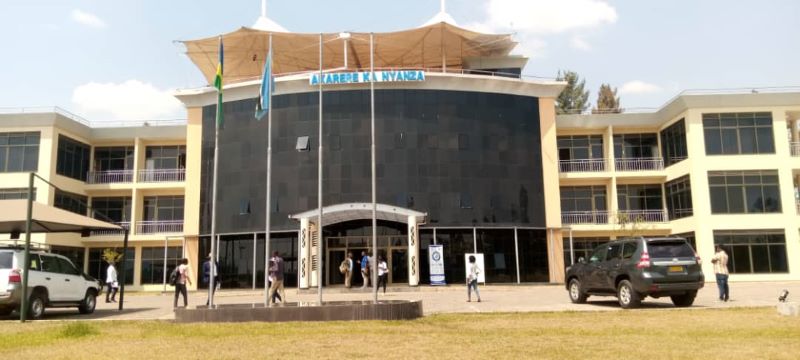
The leadership of Nyanza District has announced that 8,795 households were enrolled in the poverty graduation program over the past two years. Through linkage to various livelihood and development opportunities, 5,386 of these households have successfully moved out of poverty, demonstrating continued progress toward socio-economic transformation.
This was disclosed during a Nyanza District coordination meeting that brought together district leaders from the village level upwards, held on December 22, 2025. The meeting was attended by the Governor of the Southern Province, Kayitesi Alice.
The Director of Public Works in Nyanza District, Nsabimana Jean Christian, reported that in the 2023–2024 and 2024–2025 fiscal years, a total of 37,490 households were classified as living below the poverty line. Of these, 8,795 households were selected to benefit from the poverty graduation program aimed at improving their living conditions.
Following an assessment conducted on 8,276 households since some households had relocated and could no longer be traced it was found that 5,386 households had exited poverty. Meanwhile, 2,890 households remained below the poverty line and were reinstated on the list of vulnerable households. These households will continue to receive support under the second phase of the two-year program, running until 2027.
The Acting Mayor of Nyanza District, Kajyambere Patrick, said the district leadership has clearly identified priority interventions for lifting citizens out of poverty, with a strong focus on promoting high-productivity agriculture on limited land, as most farmers cultivate less than half a hectare.
“Nyanza District is largely agricultural. Out of 93,000 households in the district, 90 percent live in rural areas. About 76 percent of households depend on farming, yet 65 percent cultivate less than one hectare of land. Among these farmers, only 39 percent own livestock, meaning the majority farm without adequate organic fertilizer. We need to intensify efforts to ensure livestock reach our communities so they can access manure, improve soil fertility, increase production, achieve food self-sufficiency, and supply surplus to the market.” He mentioned.
Beneficiaries of the program have expressed appreciation for the progress they have made. One of them is Niyigaba Philémon from Ntyazo Sector in Nyanza District, who explained that a nearby swamp development project at Nyiramageni provided him with employment and training in modern farming techniques, enabling him to improve his livelihood.
“I gained new skills in modern farming and also got a job that helped me build working capital. I now produce more maize and plan to further increase maize yields because I can access organic fertilizer and farm more effectively. I also intend to expand my cultivated land and continue adopting improved agricultural practices.” He testified.
The Governor of the Southern Province, Kayitesi Alice, emphasized that for poverty reduction programs to yield faster results, leaders must move beyond administrative roles and work with a sense of personal responsibility, setting and fulfilling concrete performance targets so that citizens can sustainably escape poverty, in Nyanza and across the country.
“A good leader reflects more on what has not worked and seeks solutions rather than focusing only on achievements. Some leaders merely pass on instructions without taking action. We often speak—from the province to the district, from the district to the sector, all the way down but when do we actually act? We must prioritize action over words. To achieve this, we need to change our mindset.” She highlighted.
She further urged institutions to remain focused on the real needs of the citizens they serve, so that the desired development momentum can be sustained.
After the first phase, it is planned that 10,286 households will be supported under the second phase of the poverty graduation program from 2025 to 2027, where they will be linked to development opportunities to further improve their livelihoods and advance toward sustainable development.