On Friday, October 31, 2025, the Rwanda Governance Board (RGB) released the results of its 2025 Governance Assessment, highlighting performance across key pillars such as security, political rights, governance, economic management, and anti-corruption efforts.
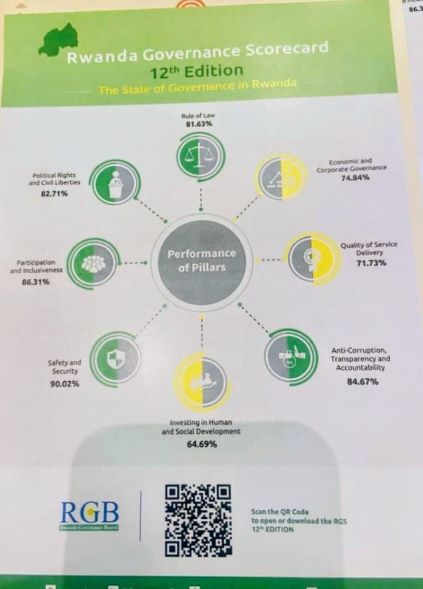
According to the report, the Security and Safety pillar ranked highest with 90.02%, showing that citizens are satisfied with the prevailing peace and security in the country. It was followed by the Participation and Inclusiveness pillar, which scored 86.31%, reflecting continued progress in involving citizens in decision making processes.
The Anti-Corruption, Transparency and Accountability pillar scored 84.67%, showing strong measures in place to curb corruption and promote transparent governance.
Political Rights and Civil Liberties received 82.71%, indicating growing confidence in political participation and respect for human rights.
The Rule of Law pillar scored 81.63%, suggesting that the legal system and justice structures remain strong, although there is still room for improvement.
Economic and Corporate Governance scored 74.84%, revealing that more effort is needed to improve the management of public and private institutions and enhance economic governance.
Quality of Service Delivery stood at 71.73%, pointing out that while services are improving, there is still a need for further enhancement to ensure consistent quality for citizens.
Finally, Investing in Human and Social Development scored the lowest with 64.69%, indicating that greater investment is needed in education, health, and social welfare programs to enhance citizens’ well-being.
Overall, the report presents a comprehensive picture of Rwanda’s governance landscape, showcasing both progress and areas that require more effort. High scores in security, citizen participation, and anti-corruption demonstrate the effectiveness of governance systems, while lower scores in social development and service delivery highlight the need for increased investment and policy focus.
RGB urged leaders and citizens to use these findings as a guide for designing policies and programs that strengthen public service delivery, improve social welfare, and promote inclusive, transparent, and accountable governance across all sectors.