On September 3, 2025, just hours before the start of the “Aviation Africa 2025” conference on advancing air transport, a major event took place.
The conference, now in its ninth edition, runs for two days until September 5, 2025, bringing together more than 80 companies operating in Africa’s aviation industry.
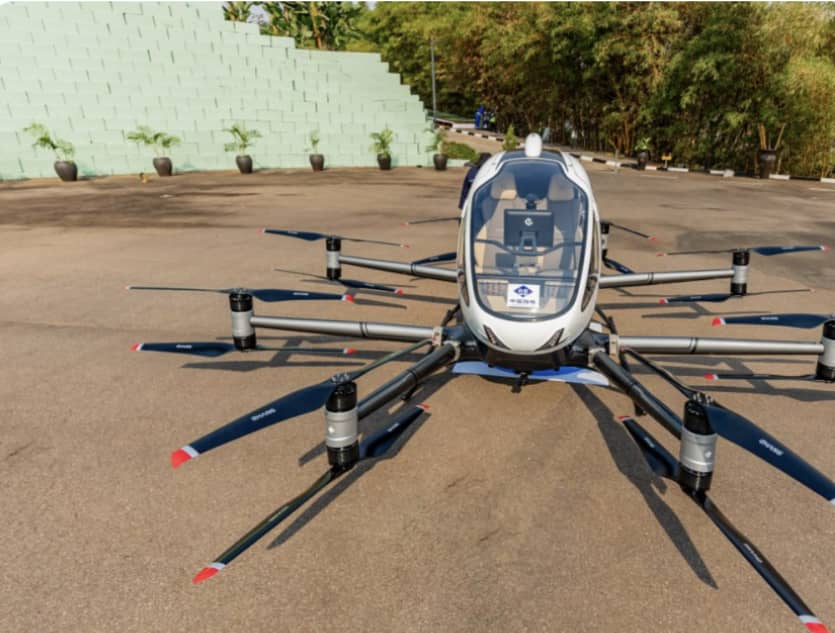
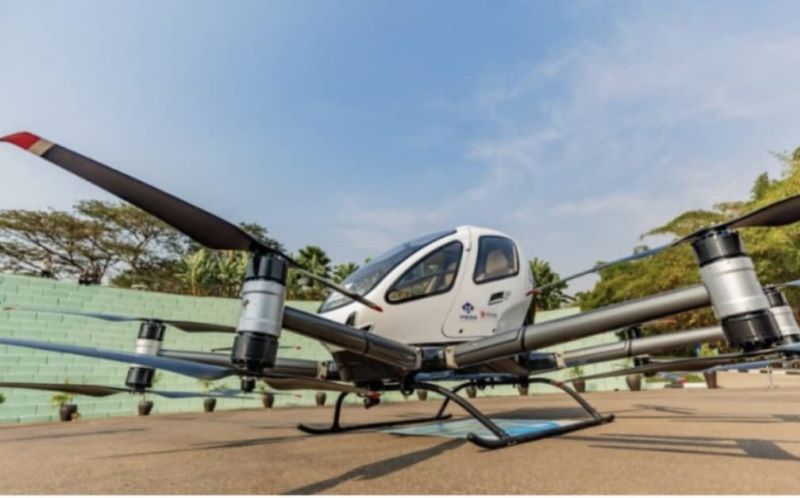
In Rwanda, new aircraft known as eVTOLs (electric Vertical Take-Off and Landing vehicles), manufactured by China’s EHang, were introduced. These aircraft are powered entirely by electricity.
One model can carry two passengers and has the capacity to transport more than 620 kilograms of cargo. It can cover a distance of 30 kilometers, flying for up to 25 minutes on a single charge. The aircraft operates at an altitude of 100 meters, has 12 propellers supported by four legs, and is equipped with technology to detect obstacles in the air.
Melissa Rusanganwa, Head of International Cooperation at the Rwanda Civil Aviation Authority (RCAA), was the first person to take a ride in the aircraft.
She said, “I felt comfortable and safe. They first checked that the aircraft was in good condition and gave us instructions to follow during the flight. This is new aviation technology that will help connect people in different areas.”
Rusanganwa added that these aircraft will also support Rwanda’s tourism sector by making it easier for visitors to explore various destinations. She emphasized that this is an environmentally friendly transport solution since the aircraft use 100% electricity.
She said, “As you know, we started with drones that deliver supplies, especially medicines and blood, to hospitals. This is another level that will boost tourism while also helping us achieve our goals of reducing harmful emissions.”
Each drone costs about $400,000. Rwanda is the 21st country to introduce these aircraft. In 2024, EHang sold 216 of them worldwide.
Previously, drones in Rwanda were mainly used for medical deliveries such as transporting medicine and other essential supplies. Most of these are operated by Zipline Rwanda, which began global operations in the country in October 2016.
Zipline drones typically carry between 2 and 3 kilograms, with batteries lasting up to three hours.
By November 2024, Zipline Rwanda had expanded its services to 654 health facilities, including over 100 small clinics, delivering blood, medicine, vaccines, and other medical supplies.
A Zipline drone can cover a distance of 160 kilometers, flying at a speed of 130 km/h. However, its longest operational route currently takes less than 40 minutes, from Muhanga to Mibilizi District Hospital in Rusizi District.
Zipline Rwanda operates along more than 500 air routes, with a similar number of designated landing areas.
Rwanda is also advancing projects to strengthen drone-based aviation. Construction is underway for a state-of-the-art Drone Operation Centre, expected to meet international standards.
The centre, located in Huye District in the Southern Province on the site of a former airstrip, will cost 13.4 billion Rwandan francs.
It will be capable of handling all types of drones, including large ones comparable in size to helicopters, with wingspans of 18 to 20 meters. Depending on drone sizes, the facility will be able to accommodate up to 3,000 drones at once.
The Drone Operation Centre will be unique, with dedicated facilities for assembling new drones and testing them before deployment.