


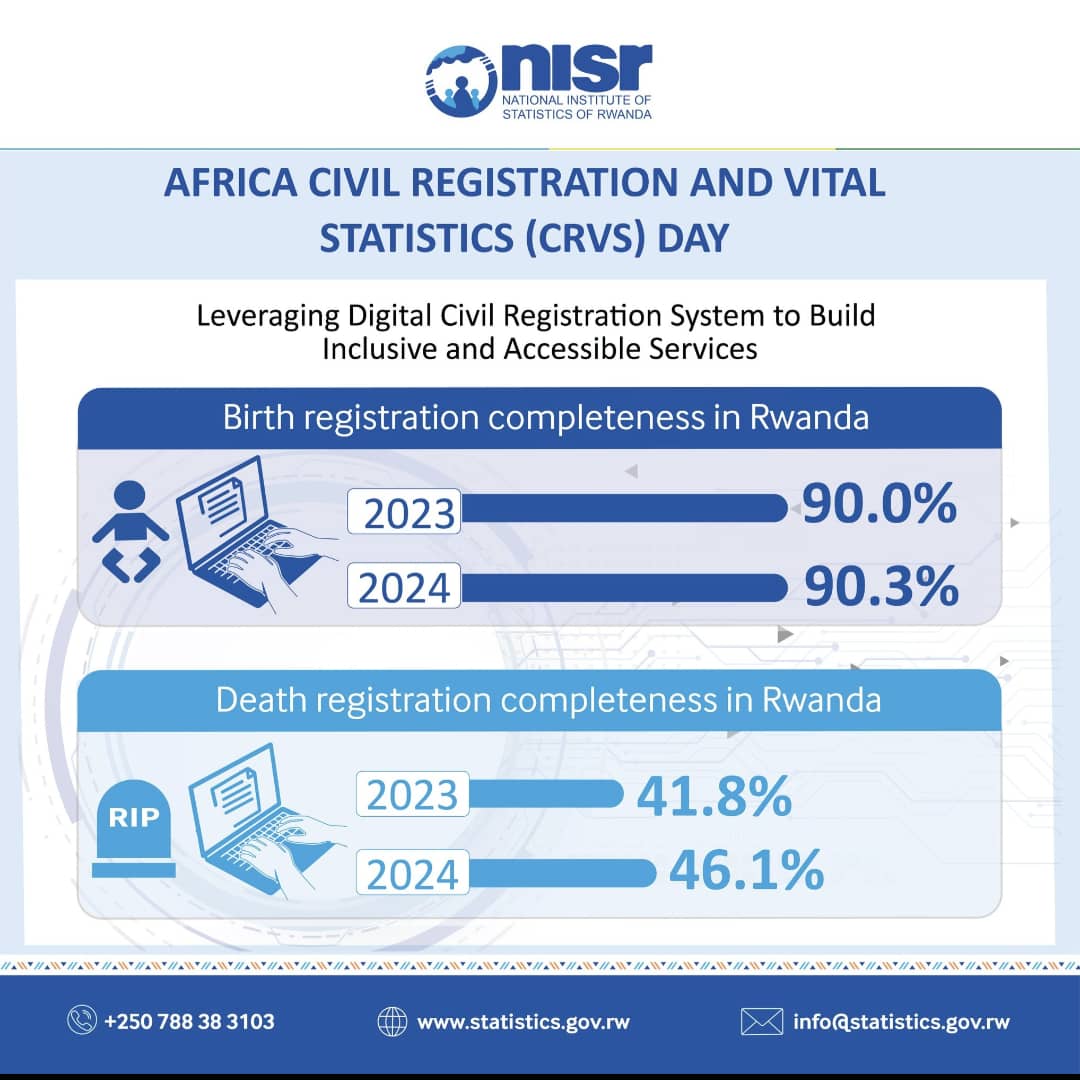
According to figures released by the National Institute of Statistics of Rwanda (NISR), of the more than 340,000 children born annually in Rwanda, approximately 10% are not registered at civil registration offices, particularly those located within hospitals.
This data was shared in Muganza Sector, Nyaruguru District, on August 12, 2025, during celebrations marking Africa Civil Registration and Vital Statistics Day, followed by a week focused on promoting civil registration services.
Failing to register children in the civil registry not only hinders effective planning but also prevents individuals from accessing essential services later in life.
When traveling around the country, it’s common to encounter people facing civil registration issues, such as children not registered under their parents’ names, couples who claim to be married but are not legally registered, among others.
For example, at the Muganza Sector Office, long queues are common, with people trying to fix issues such as missing from the national digital system, being eligible for a national ID but lacking official records, or having incorrect personal data.
Eugénie Mukantagara, a resident of Murambya Village, Uwacyiza Cell, shared:
“My child went to take a photo to apply for a national ID but couldn’t proceed because he wasn’t registered. I came to register him so he can take the photo. I had assumed he was already registered, but I was surprised to find out he wasn’t.”
Jean Claude Mwiseneza, the Civil Registration Officer in Muganza Sector, Nyaruguru District, said they frequently deal with such problems. These include teenagers trying to get national IDs and discovering their names aren’t in the system, or cases where ID photos are poor, IDs contain errors, and so on. He urged people to address such issues promptly.
Patrick Nshimiyimana, the civil registration officer at NISR, noted that aside from the 10% of unregistered births, around 54% of deaths each year also go unregistered.
He explained:
“Think about it, if 10% of children are not registered each year, over five years that’s a large number. Over 30,000 children annually go unregistered. When you add the 54% of deaths that aren’t recorded, that’s a significant population.”
Nshimiyimana said the failure to register deaths is mostly due to cultural practices that prioritize quick burials and mourning over official processes like registering the deceased.
He warned that this has consequences, for government planning, for the deceased’s families (especially in cases of inheritance), and for understanding the causes behind deaths.
He added:
“This data helps us know what caused those deaths, which is vital for designing effective health policies. If we don’t collect this information, we miss out on knowing what’s behind these deaths. This affects individuals, families, national statistics, and government planning. That’s why it’s something people should take seriously.”
Nshimiyimana shared that a new initiative is being launched to make death registration more accessible, including registering at the community level (villages) or having health facilities handle the process , in order to ease service access.
This complements an existing program where newborns are registered directly at birth at the health facilities where they are born.
Marie Solange Kayisire, the Minister of State in the Ministry of Local Government, said the long-term solution to civil registration challenges lies in the fact that all civil registry books arenowdigitized, preventing future losses of records.
She stated that civilregistration services have been brought closer to the people, reducing the need for long, expensive journeys.
“Now, those born or who die in hospitals are registered there. Those born or who die outside health facilities are registered at the cell level, and this service is free of charge. Civil registration services are also available at sector offices and in Rwandan embassies abroad to make the process easier.”
Civil registration is more than a formality; it’s a fundamental human right and a key component of national development and public service delivery. The government urges all citizens to take it seriously, whether it’s registering a birth, a death, or correcting errors in civil records.