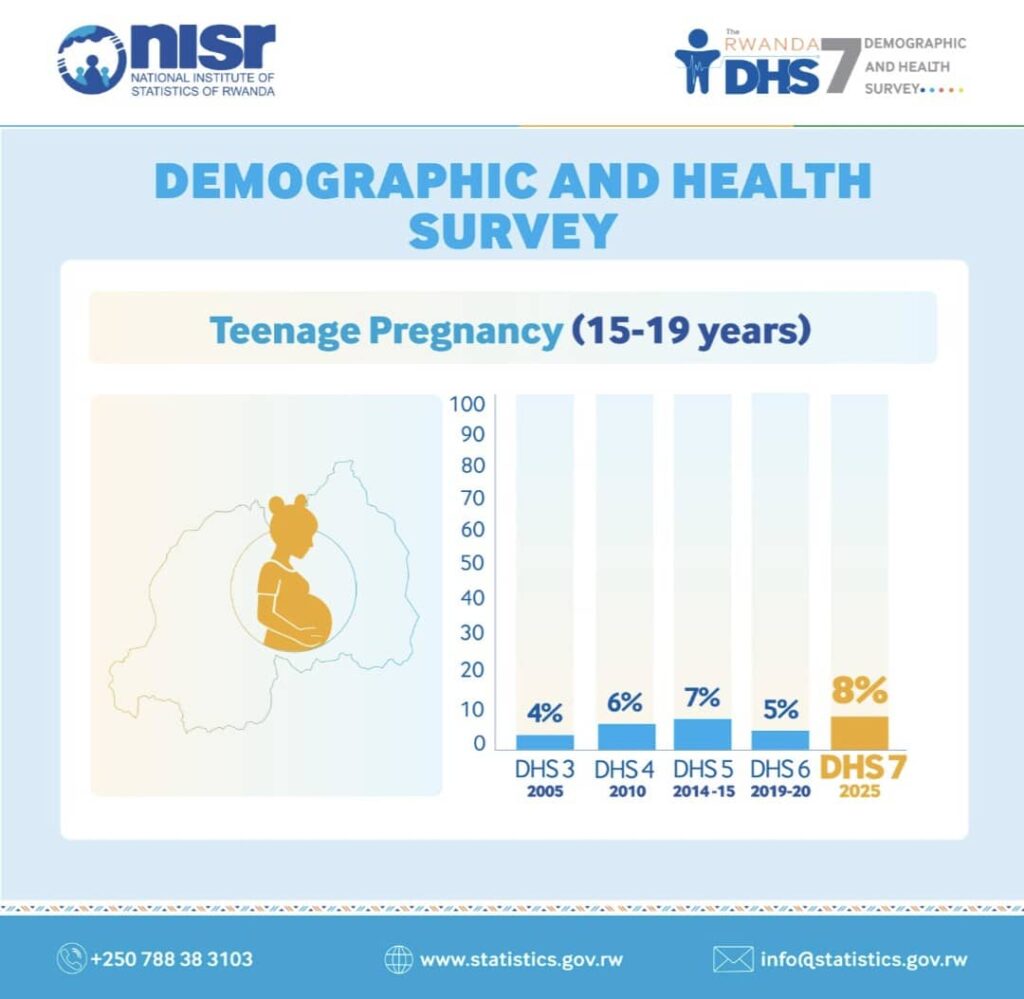
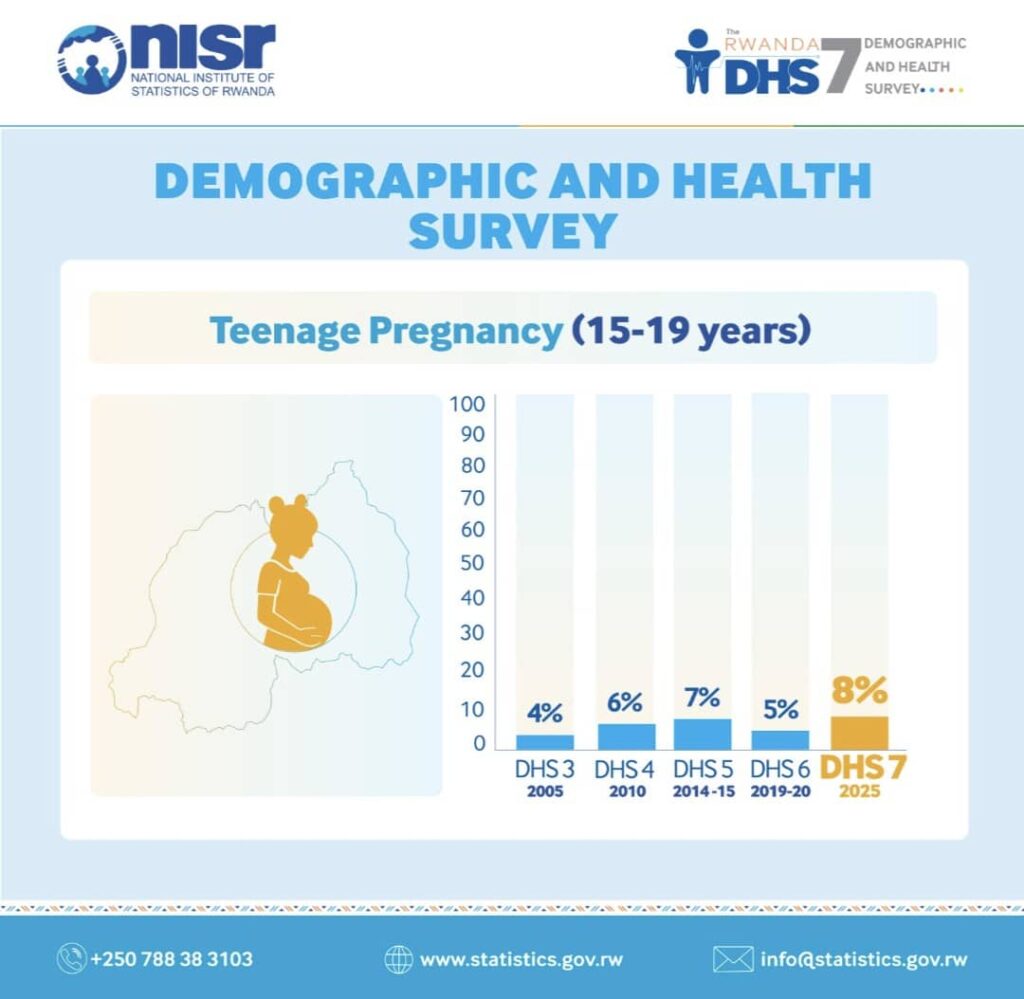
A new national survey has revealed a worrying rise in teenage pregnancies in Rwanda over the past five years. According to the Seventh Demographic and Health Survey (DHS 7) conducted by the National Institute of Statistics of Rwanda (NISR), the percentage of girls aged 15 to 19 who have experienced pregnancy increased from 5% in 2020 to 8%t in 2025. This means that at least one in every 13 teenage girls is already facing the responsibility of motherhood. The survey, which is carried out every five years, was officially presented on Wednesday, December 17, 2025.
The findings show that teenage pregnancy is most prevalent among girls with no formal education, who account for 21% of cases. This is followed by girls who completed only primary education 13%, while the rate among those with secondary education is significantly lower at 4%.
Speaking on the issue, Dr. Anicet Nzabonimpa, a reproductive health specialist attributed the rise to several factors, including limited access to adolescent-friendly reproductive health services and problems within families. “Frankly speaking, many young people do not feel free or comfortable accessing health services.” He stated.
Dr. Anicet pointed out that although the Ministry of Health requires health facilities to set up youth-friendly corners, many facilities either do not have them or have spaces that exist only in name and are not fully functional. He also linked the increase in teenage pregnancies to family instability, particularly the growing number of divorces. According to him, children are often the most affected.
“When families break down, children may develop behaviors that expose them to risky practices, including engaging in sexual activity at a very young age.” He explained. Dr. Anicet emphasized that addressing teenage pregnancy requires joint efforts from different sectors, including government institutions, development partners, and religious leaders.
He called on faith-based organizations to become more involved, saying they need to understand the challenges facing young people and take part in finding solutions so that all stakeholders can work together.
He further stressed the importance of laws that allow adolescents to freely access reproductive health information and services, noting that strong implementation is just as important as the laws themselves. “Services must be available, and young people should be encouraged to use them.” He added.

The Health Development Initiative (HDI), a non-governmental organization working on reproductive health advocacy in Rwanda, also believes more work needs to be done. Diane Igihozo, HDI’s Legal and Advocacy Officer said the survey results show that advocates still face a major task.
“These numbers show that we still have a long way to go,” she said, adding that gaps remain in reaching all districts, all health service providers, and ensuring that young people are fully aware of their reproductive health rights.”

In a move expected to improve access to health care for young people, Rwanda’s Parliament passed a new health services law in August 2025. The law allows adolescents aged 15 and above to independently consent to medical services without being accompanied by parents or guardians. It was officially published in the Government Gazette in September 2025, allowing it to take effect.
Under the new law, adolescents can now access services such as contraception on their own services that previously required parental consent.
Both Dr. Anicet Nzabonimpa and Diane Igihozo believe the law will play an important role in reducing unintended teenage pregnancies. “We expect positive results, and I am confident they will come,” Dr. Anicet said.
However, He cautioned that health workers must be properly trained and reassured so they can provide these services without fear of legal repercussions. Diane Igihozo added that in the past, many adolescents faced barriers such as lack of information, parental refusal, and limited privacy when seeking services.
Both experts are now calling on relevant authorities to develop clear guidelines to support effective implementation of the law, warning that without proper follow-through, the law risks remaining on paper without producing real change.