


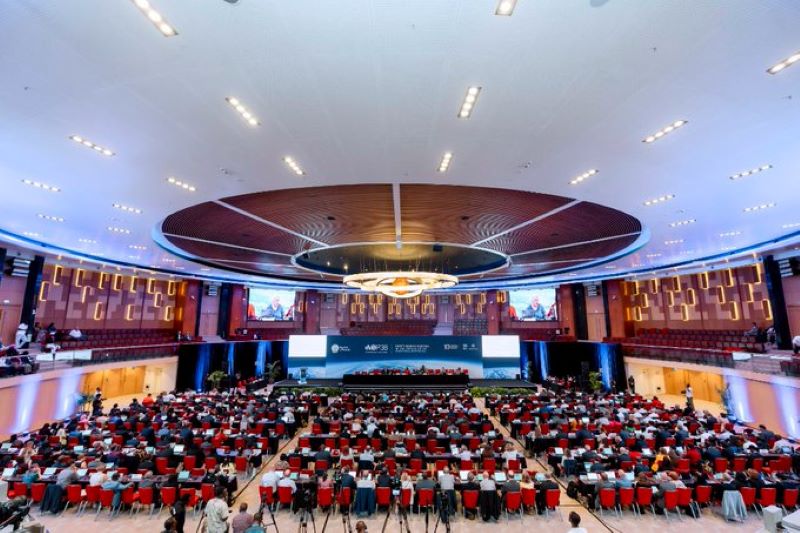
Rwanda has called on countries to translate their commitments under the Kigali Amendment into concrete action, as the 38th Meeting of the Parties to the Montreal Protocol (MOP38) continues in Kigali, with discussions focusing on sustainable cooling, climate financing and emerging threats to the ozone layer.
The five-day meeting, which runs from November 2 to 6 at the Kigali Convention Centre, has brought together approximately 1,000 delegates representing governments, international organizations, environmental experts and industry stakeholders.
Wednesday’s discussions, November 4, included deliberations on the need to strengthen global ozone protection efforts, alongside a side event examining the growing threat posed by nitrous oxide emissions.
The meeting comes 10 years after the adoption of the Kigali Amendment in October 2016, when countries agreed to gradually reduce the production and consumption of hydro fluorocarbons (HFCs), powerful greenhouse gases commonly used in refrigeration and air-conditioning systems.
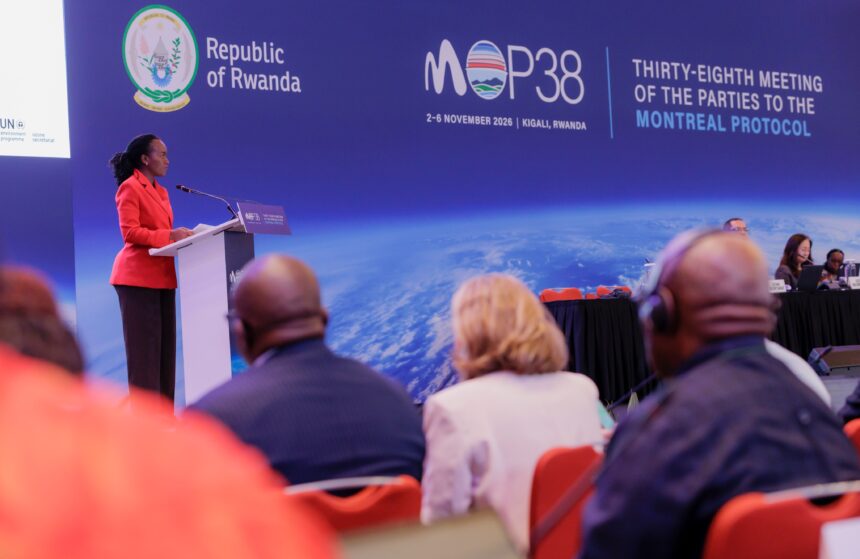
Rwanda’s Minister of Environment, Dr Bernadette Arakwiye, has urged participating countries to use the anniversary to renew their commitment to the agreement and accelerate its implementation.
Speaking at the opening of MOP38 on November 2, Arakwiye said returning to Kigali after a decade provided an opportunity to reflect on the progress achieved while identifying areas requiring further action.
“It marks ten years of dedicated work, of careful preparation, and of implementation getting under way. It confirms the vision we set in 2016, and it asks us to keep building swiftly towards the future,” she said.
The Minister also called on countries to endorse the Kigali+10 Declaration, join the Friends of the Kigali Amendment initiative and ensure that commitments made during the meeting are incorporated into national plans.
“We ask you to endorse the Kigali+10 Declaration. We invite you to join the Friends of the Kigali Amendment, launched in New York together with Brazil and the United Kingdom. And we ask you to carry what you agree here back home, and into your national plans,” Arakwiye said.
Countries discuss financing and ozone protection
One of the central issues under discussion at MOP38 is the replenishment of the Montreal Protocol’s Multilateral Fund for the 2027–2029 periods.
The fund supports developing countries in implementing their obligations under the agreement, including phasing out ozone-depleting substances and reducing the use of HFCs.
According to an assessment presented to delegates, the funding required for the next three-year period is estimated at between $1.23 billion and $1.692 billion.
Countries are discussing the estimates and the resources needed to ensure that developing nations can access the technology, training and financial support required to meet their commitments.
Another issue receiving attention is the unexplained gap between reported emissions of HFC-23 and estimates derived from atmospheric measurements.
HFC-23 is an extremely potent greenhouse gas, with a global warming potential approximately 14,500 times that of carbon dioxide over 100 years.
Delegates have discussed the need for improved monitoring; reporting and scientific assessments to better understand the discrepancy.
Emerging threat to the ozone layer
Wednesday’s programme also featured a side event organized by the Environmental Investigation Agency (EIA) and Germany’s GIZ-supported initiatives, focusing on nitrous oxide (N₂O) as an emerging threat to ozone protection.
Experts discussed scientific evidence showing that nitrous oxide is currently the most significant uncontrolled ozone-depleting emission and explored possible measures to address the challenge.
The discussions highlighted the importance of strengthening international environmental cooperation beyond the substances already regulated under the Montreal Protocol.
Why the Kigali Amendment matters
The Montreal Protocol was signed on September 16, 1987, in Montreal, Canada, to protect the Earth’s ozone layer by phasing out chemicals responsible for its depletion.
The agreement has enabled the gradual elimination of the vast majority of ozone-depleting substances globally, placing the ozone layer on a path towards recovery.
In October 2016, countries adopted the Kigali Amendment in Rwanda’s capital, extending the treaty’s contribution to climate action through the gradual reduction of HFCs.
Full implementation of the amendment could prevent up to 0.5 degrees Celsius of global warming by the end of the century. Beyond reducing emissions, the transition to climate-friendly refrigerants and energy-efficient cooling equipment is expected to bring benefits to sectors such as healthcare, agriculture, food preservation and economic development.
The Executive Secretary of the United Nations Environment Programme’s Ozone Secretariat, Megumi Seki, has also emphasized the importance of maintaining international cooperation to achieve the agreement’s objectives.
“The Montreal Protocol has demonstrated what sustained international cooperation can achieve,” she said, calling on countries to strengthen implementation for the next decade.
As MOP38 enters its final days, delegates are expected to continue negotiations on financing, institutional arrangements and measures to strengthen the implementation of the Montreal Protocol.
For Rwanda, hosting the meeting a decade after the adoption of the Kigali Amendment provides an opportunity to bring international attention back to the agreement and encourage countries to turn the commitments made in Kigali into measurable environmental action.