


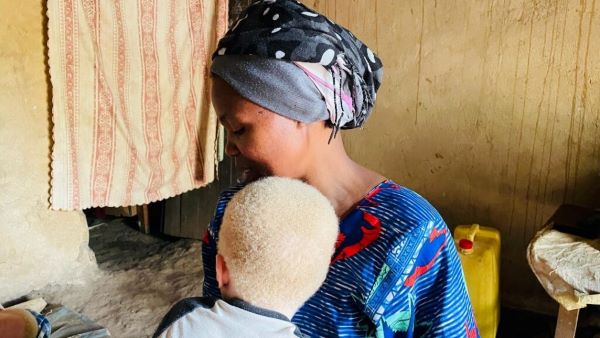
The women who give birth to children with albinism in Rwanda, often face immediate social rejection, beginning at childbirth and continuing through the child’s upbringing. These mothers report being shunned, denied housing, and subjected to heartbreaking levels of stigma.
Marie Jeanne Mushimiyimana, shared her story, recalling the confusion and trauma she experienced when her first child was born at Kabgayi Hospital in Rwanda’s Southern Province in 2016. After moving in with her partner in 2015, she delivered a baby boy via Caesarean section a year later. What should have been a joyous moment was quickly marred by confusion and insensitivity.
“Right after delivery, I was still very weak when doctors started questioning me, asking if my child’s father was white,” she remembered in a June 2025 interview. “They pointed out his pale skin and unusual eyes. I went into shock.”
Despite the shock, Mushimiyimana says she embraced her child immediately. “Lying in that recovery bed, I felt a strong connection and told myself, ‘This child is God’s gift.’ I had never seen a baby like him before.”
However, her husband’s reaction deepened her trauma. He took one look at the baby and, questioning the child’s appearance, walked out of the hospital, never to return. What followed was a painful silence. “No one came to visit me. Not even my mother-in-law. Only my mother and sister were by my side,” she recounted.
A year later, her partner abandoned her entirely, unaware that she was pregnant again. “When I found out, I prayed the second child would also have albinism. I was afraid that if she looked different, people would doubt who her father was.”
Her second child, born at Kacyiru District Hospital, was indeed born with albinism. “As she was delivered, I overheard the medical team wondering about her skin. I calmly told them, ‘Accept her, she’s just like my firstborn.”
Today, Mushimiyimana, now a mother of four, lives in Gisozi Sector, Gasabo District. Her youngest son, a twin, also has albinism, while his sister does not. All her children are registered under her name alone; their father remains absent from their lives.
Facing a Hostile Society
Her journey has been fraught with social rejection. One of the clearest signs came when her landlord abruptly raised her rent from Rwf 30,000 to Rwf 40,000. “He was trying to get me to leave. When I didn’t budge, he returned my money and told me to vacate,” she said.
In several neighborhoods, she faced similar hostility. “In three different houses, tenants openly said they lost their appetite because of my children,” she shared. The discrimination wasn’t just verbal; her children were sometimes attacked while playing outside. Although she reported the incidents, local authorities often failed to intervene.
The discrimination extended into her attempts to earn a living. She once tried selling fruits, avocados and bananas, only to find no customers. “People believed buying from me would cause their children to be born with albinism,” she said with a quivering voice. “I had to give the fruit away.”
A Glimmer of Support
Marie Jeanne’s story mirrors that of Margaret Iradukunda, a mother from Bumbogo Sector who gave birth to twin boys with albinism. When she returned home from the hospital, neighbors mocked her children, calling them “aliens.” She was so distraught she began hiding them from visitors.
The turning point came when a journalist visited her home and held one of the babies publicly. “People started seeing them as real children. Eventually, neighbors even asked to take them outside. That’s when I started accepting them myself,” she said.
Fortunately, Iradukunda had her husband’s full support. “People accused me of being unfaithful, said the children were cursed. But my husband stood by me,” she said. Unfortunately, his solidarity came at a price.
Her husband, Désiré Ushizimpumpu, lost his job after his boss saw the twins and realized they had albinism. “He had congratulated me on their birth, but after seeing them, everything changed. He dismissed me,” he recalled. Since then, Ushizimpumpu has struggled to find work. “People called my children a curse. Employers refused to take me in. It was devastating.”
Understanding the Condition
According to the 2022 Population and Housing Census, 1,864 Rwandans over the age of five live with albinism, most in rural areas. Despite educational efforts, many still lack basic understanding of the genetic roots of the condition.
Dr. Amani Uwajeni Alice, a dermatologist at the University Teaching Hospital of Kigali (CHUK), explained that albinism is inherited when both parents carry the gene. “It’s an autosomal recessive disorder, both parents must pass on the gene for a child to have albinism,” she said. The condition affects skin, hair, and eyes due to a lack of melanin, a pigment that also helps protect against UV rays.”
“There’s no room for blame here,” Dr. Amani added. “Parents should not face judgment; this is a matter of genetics.”
Pushing for Rights and Awareness
The Organization for Integration and Promotion of People with Albinism (OIPPA) has been working to combat the stigma, particularly in rural communities. “Too often, women are abandoned, children grow up unsupported, and misinformation spreads,” said Charles Komezusenge, the group’s vice president.
He noted that many fathers have returned to their families following OIPPA’s outreach efforts. “We teach families what albinism truly is and remind them that abuse is illegal. Our aim is to empower both children and parents.”
Although the Rwanda Biomedical Centre (RBC) says it has received no formal reports of stigma, the National Council of Persons with Disabilities (NCPD) acknowledges that the problem persists. “When a nurse or midwife uses dehumanizing language, that’s unacceptable,” said Emmanuel Ndayisaba, NCPD’s Executive Secretary.
He urged mothers to speak out, even after leaving the hospital. “Report any mistreatment. Institutions and individuals alike must be held accountable,” he said.