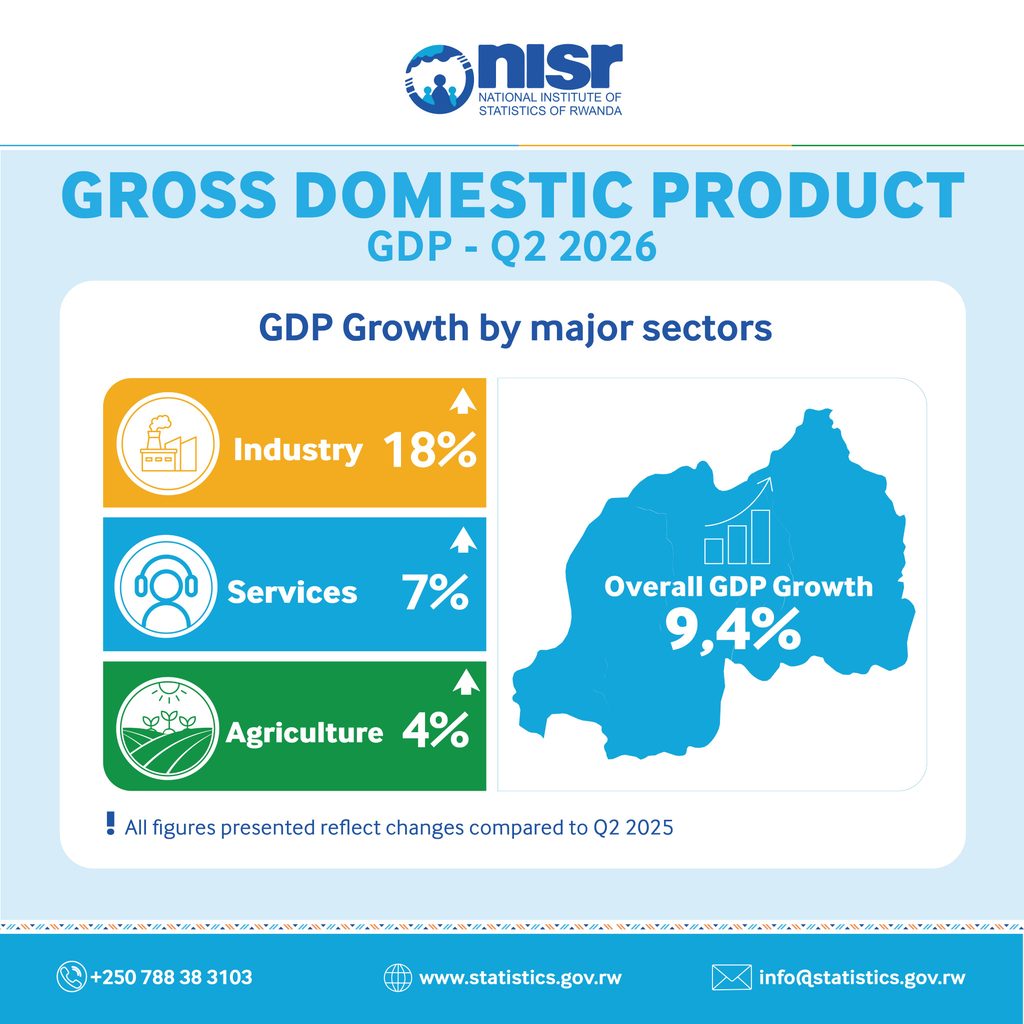
Rwanda’s economy expanded by 9.4 % year-on-year in the second quarter of 2026, as strong performances in industry and services helped drive another quarter of economic expansion. The latest figures from the National Institute of Statistics of Rwanda (NISR), released on September 15, show that Gross Domestic Product (GDP) at current market prices reached Frw7.174 trillion, up from Frw5.799 trillion in the second quarter of 2025.
The figures, however, need to be read carefully. The Frw7.174 trillion represents GDP measured at current market prices, while the 9.4 % figure represents the growth in GDP at constant 2024 prices and is therefore the key measure of real year-on-year economic growth.
The latest performance follows a 10 % year-on-year GDP growth recorded in the first quarter of 2026, meaning the economy maintained a high rate of expansion through the first half of the year. But behind the headline growth rate is a more detailed story about where economic activity is taking place.
According to NISR, the sector expanded by 18 % and contributed 3.9 percentage points to the overall 9.4 % GDP growth. The performance was supported by strong growth in mining and quarrying, construction and manufacturing. Mining and quarrying increased by 26%, while construction activities grew by 24 %.
Within manufacturing, the strongest increase was recorded in the production of metal products, machinery and equipment, which rose by 51%. Manufacturing of non-metallic mineral products increased by 22%, while textiles and leather products grew by 13%. Food processing, meanwhile, recorded a more modest 2 %t increase.
The figures suggest that the industrial side of the economy was an important source of the quarter’s expansion, with activity extending from extraction and construction to the production of manufactured goods. Industry accounted for 23 % of Rwanda’s GDP during the quarter, making it the second largest of the three major sectors by share of total output.
While industry recorded the strongest growth rate, services remained the largest component of the Rwandan economy. The services sector accounted for 51% of GDP in the second quarter, compared with 23 % for industry and 21 % for agriculture. Net indirect taxes accounted for the remaining 5 percent.
Services grew by 7%, contributing 3.7% points to the overall GDP growth rate.
Wholesale and retail trade increased by 18%, while information and communication services recorded particularly strong growth of 29 %. Transport services grew by 7 %, financial services by 4 %, and administration and support services by 9 %.
Agriculture, which accounted for 21% of GDP, grew by 4 % in the second quarter and contributed 1 percentage point to overall GDP growth. Food crop production increased by 5%, while livestock production grew by 6%. Forestry also increased by 6%, and fishing recorded a significant 66% increase.
The production figures are complemented by changes on the expenditure side of the economy.
Household consumption remained a major component of GDP, with private final consumption expenditure accounting for 74% of GDP during the quarter.
Government final consumption accounted for 14 %, while gross capital formation was estimated at 25 % of GDP. Household final consumption rose by 13 %, while government final consumption declined by 6%. Investment activity was also strong. Gross capital formation increased by 32% during the quarter.
Exports of goods and services increased by 19%, while imports grew by 36%.
The expenditure figures therefore point to several forces operating simultaneously: higher household consumption, increased investment and expanding trade flows. The increase in GDP from Frw5.799 trillion in Q2 2025 to Frw7.174 trillion in Q2 2026 is equivalent to an increase of about Frw1.375 trillion in current-price GDP.
The challenge for the months ahead will be to see whether this pace of expansion can be sustained and how it translates into employment, household incomes, investment and broader economic opportunities. For now, the Q2 figures provide another indication that Rwanda entered the second half of 2026 after two consecutive quarters of strong economic growth of 10% in Q1 and 9.4% in Q2 with industry and services doing much of the heavy lifting.