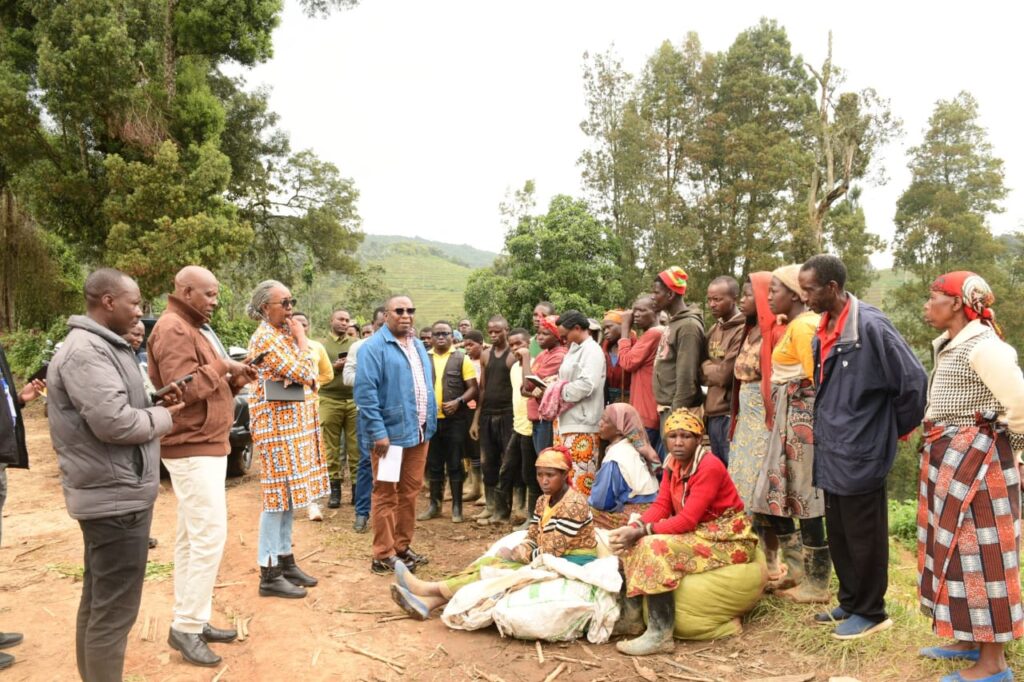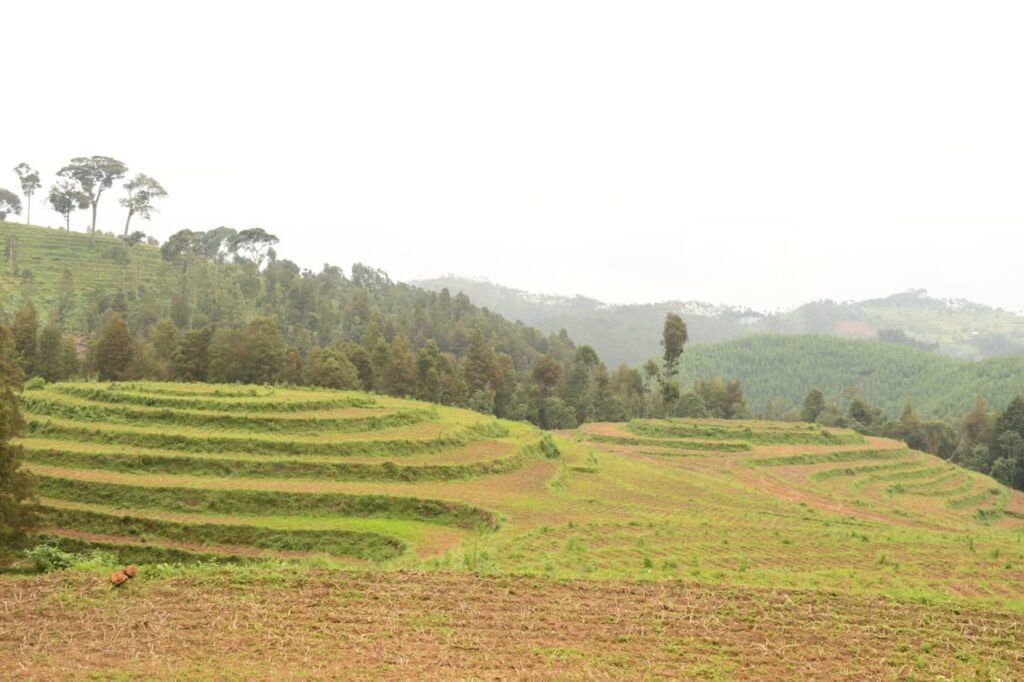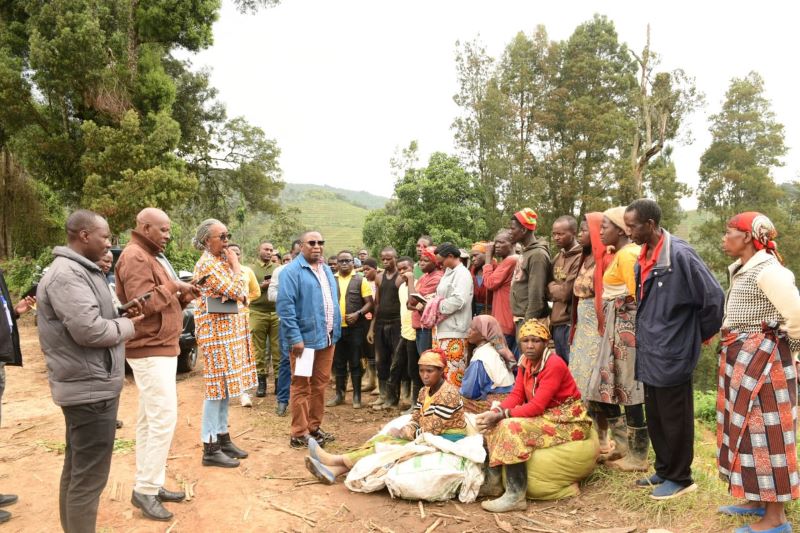
Senators Amandin Rugira and Bibiane Gahamanyi , members of the Senate Committee on Foreign Affairs, Cooperation and Security, held discussions with farmers cultivating land along the buffer zone of Nyungwe National Park regarding crop destruction caused by wild animals and the process of receiving compensation.
The meeting took place with farmers from Kintobo Village, Kagano Cell, Kitabi Sector in Nyamagabe District, where the senators were conducting a field visit aimed at engaging citizens, listening to their concerns, and exploring possible solutions.
Farmers who own large farms near the park told the senators that during the past three years of farming along the park’s buffer zone, they have not had to apply for compensation because they established strong protective measures to prevent animals from damaging their crops.
Gaspard Tuyiringire explained that while these protective measures are effective, they are also costly.
“We put in place ways to protect our crops so that animals from the park do not destroy them. This means we rarely have to request compensation, but the protection itself is very expensive,” he said.
However, small-scale farmers say their crops are frequently destroyed by animals coming from Nyungwe, yet they do not always receive proper compensation.
They noted that officers responsible for assessing the damage often arrive late, by which time evidence of the destruction may have already disappeared.
Jean Pierre Manirakiza said:“Animals come and eat our crops, but when the officials responsible for assessing the damage arrive late, they find that the evidence has already disappeared. At that point we do not receive compensation, even though the losses are significant.”
Thadee Habimana, the Vice Mayor of Nyamagabe District in charge of Economic Development, said that any farmer whose crops are destroyed by animals from Nyungwe should receive compensation as long as the case is reported through the proper procedures.
“No farmer whose crops are destroyed by animals from Nyungwe should miss compensation if the issue has been reported through the official channels,” he said.
He also called for services related to assessing wildlife damage to be brought closer to local communities.
“We would like to have a permanent officer based in Nyamagabe responsible for assessing damage caused by animals. This would help citizens receive faster services because sometimes when inspectors arrive, the evidence has already disappeared,” he added.
The senators said their visit to communities living near Nyungwe National Park was aimed at listening to citizens’ concerns and advocating for solutions.
Senator Amandin Rugira noted that farmers’ views would be taken into consideration to improve both compensation mechanisms and crop protection strategies.
“We came to listen to citizens’ concerns and see how they can be addressed. The issues raised by farmers are important, and we will follow them up to see how compensation services can be improved,” he said.
Senator Bibiane Gahamanyi emphasized that collaboration between institutions and local communities is essential to finding lasting solutions to wildlife-related crop damage.
“It is important for responsible institutions to work together with citizens so that sustainable solutions can be found to the problem of animals destroying crops, allowing agriculture to continue developing,” she said.
The senators added that the views and concerns raised during the visit would be submitted to relevant institutions for further consideration and long-term solutions.
In 2023, the United Nations Educational, Scientific and Cultural Organization (UNESCO) officially listed Nyungwe National Park, located in Rwanda’s Southern and Western Provinces, as a World Heritage Site.
Nyungwe is known for its rich biodiversity, hosting more than 85 species of mammals, including more than 12% of Africa’s primate species, excluding those found on the island of Madagascar. The park spans 1,019 square kilometers across five districts: Nyaruguru, Nyamagabe, Karongi, Rusizi, and Nyamasheke.
The management of Nyungwe National Park also reports that more than RWF 1.2 billion generated from tourism will support six community projects in districts surrounding the park through the revenue-sharing program for communities living near protected areas in 2026.