


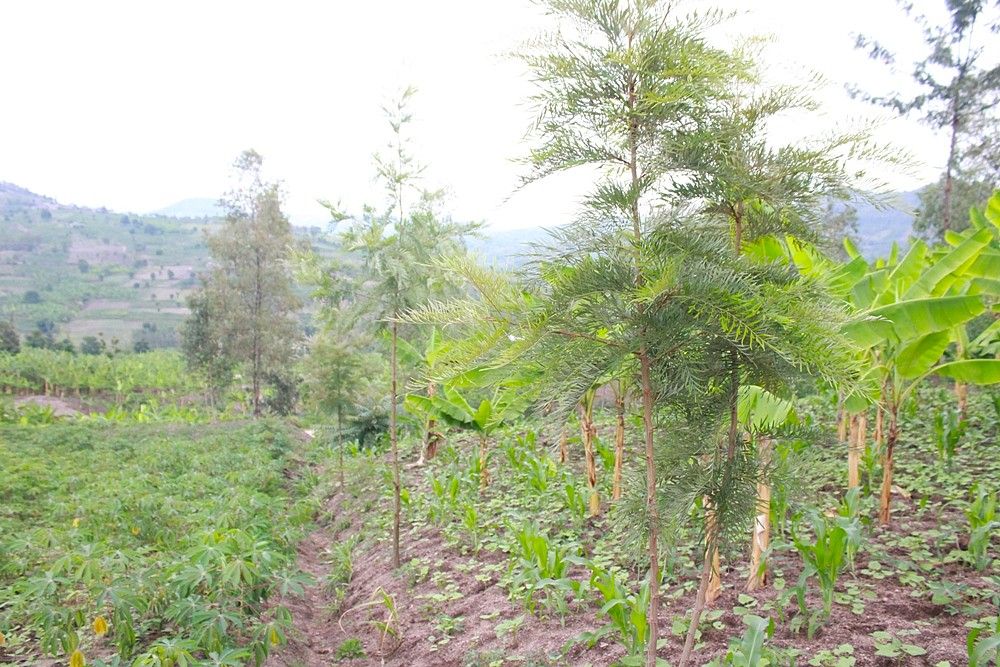
Environmental experts recommend finding alternative tree species to replace grevillea in the Amayaga region because, although it coexists well with crops, once it is mature and cut down, it does not regenerate. Since it is the dominant tree species, they fear that if all of it is harvested at once, the region could face the climate change issues like conditions. Based on this, they are calling for action to identify alternative tree species.
Ndereyimana Théoneste, the environmental officer of Ruhango District, said that planting grevillea trees is beneficial because they protect the soil and improve air quality. However, when they mature and are harvested at the same time, the area tends to revert to a desert-like state.
He said, “In Amayaga, we face the challenge that grevillea is widely planted, and once cut, it does not regrow. If all mature trees are harvested at once, the hills are left bare again.”
He pointed out that the Green Amayaga project has revived forestry in this region, including Ruhango, but there are concerns that when the predominantly grevillea trees are eventually cut down, the region could regress and become desert.
He added, “When trees are planted at the same time, they grow and are harvested at the same time. It’s hard to prevent people from harvesting them. There is concern that once this happens, Amayaga could return to the harsh conditions as previously experienced.”
This concern also shared by Ngayaberura Jean Damascène, a resident of Nyanza District, who noted that aside from the fact that grevillea does not regenerate once cut, some residents prune them excessively while they are still young, often leaving the trees with few leaves, which is another problem.
Rushema Emmanuel, an official from the Rwanda Environment Management Authority (REMA), stated that there are many tree species that can be mixed with crops instead of grevillea. He mentioned that when necessary, the Rwanda Forestry Authority (RFA) could provide guidelines on alternative species to plant in the Amayaga region.
He said, “That’s a valid concern. RFA can give guidance on tree species that could replace grevillea, since it does not regenerate. The Amayaga region is especially vulnerable due to its lack of the forest cover.”
Through the Green Amayaga project trees were planted on residents’ farms, along roadsides, and near rivers in the districts of Gisagara, Nyanza, Ruhango, and Kamonyi. Anti-erosion ditches were also dug and planted with livestock fodder,
In all these efforts, grevillea trees have been the most commonly planted, reason why there are concerns that if they are harvested and do not regenerate, the Amayaga region could again face serious environmental risks.
Nyampinga Aline